
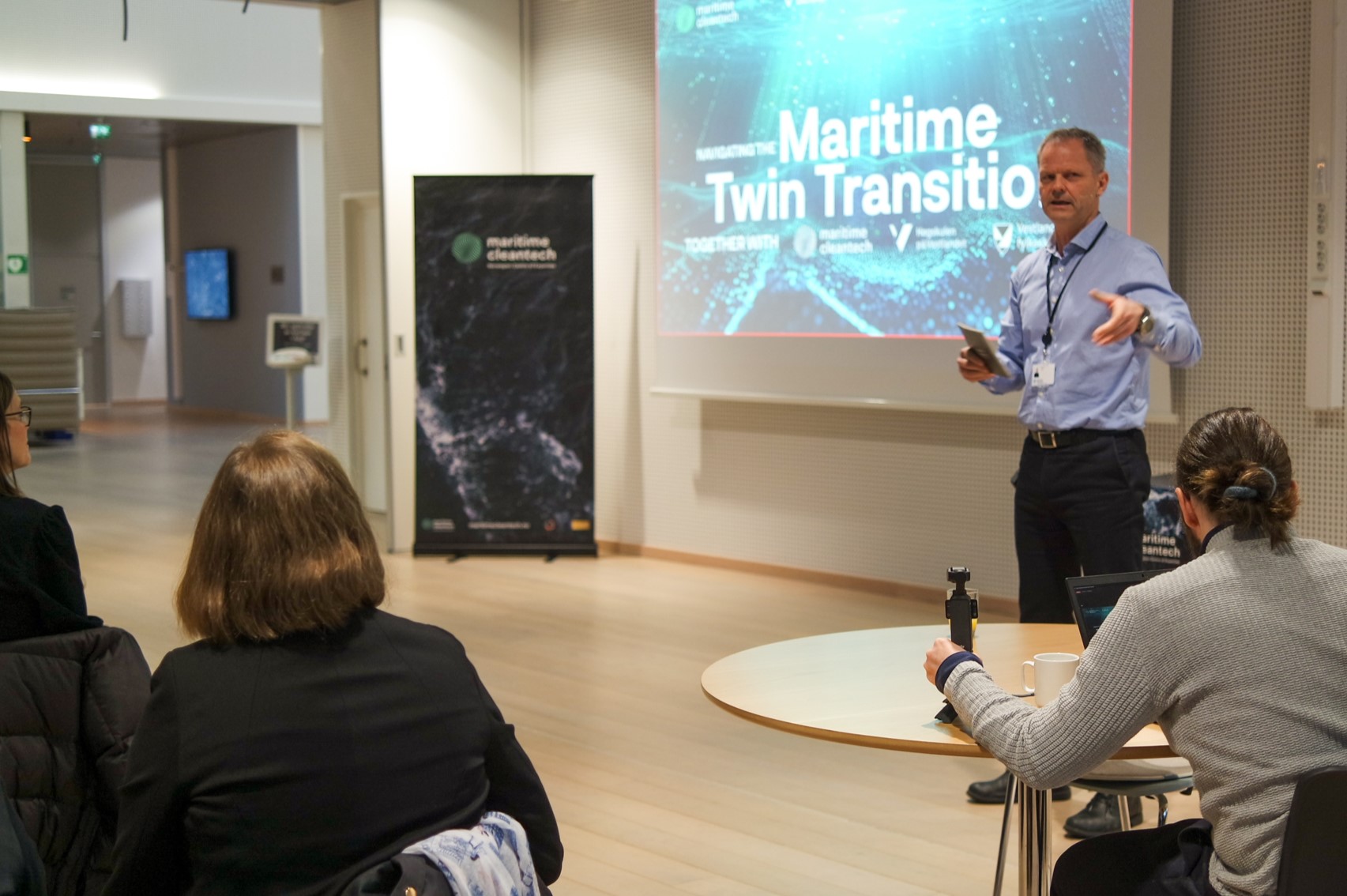
Øystein Huglen, Head of Technology and Innovation, presenting at the Maritime Twin Transition seminar in Bergen.
Maritime CleanTech has unveiled an ambitious strategy to drive the Maritime Twin Transition—integrating the green and digital transformations critical for the maritime industry's sustainable future.
The Maritime Twin Transition seeks to align the increasing digitalization of maritime operations with the global imperative to decarbonize.The strategy was launched at a recent seminar in Bergen, which gathered key stakeholders in the twin transition to discuss the potential synergy between these megatrends for the maritime industry.
Digitalization and Decarbonization: A Dynamic Duo
"In a world of scarcity, reducing overall energy consumption becomes increasingly important for decarbonisation. We simply must find smarter ways to reduce energy consumption. And to do it smarter we tend to rely more and more on digital solutions. The overlap between the green and digital transformations thus holds enormous potential," says Øystein Huglen, Head of Technology and Innovation at Maritime CleanTech. “Effective digitalization, coupled with clean energy, can lead us to a zero-emissions future.”
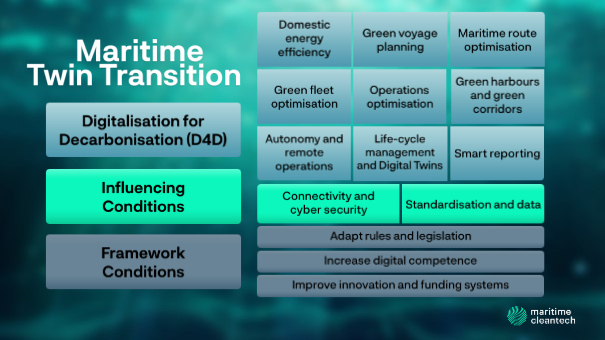
Maritime CleanTech's comprehensive assessment, conducted with input from over 40 stakeholders, has identified nine thematic areas critical to achieving emissions reductions through digital innovation.These include energy efficiency, green fleet optimization, route planning, and advanced lifecycle management for ships.
Empowering Change with Innovation and Collaboration
The survey also pinpointed key framework conditions that must be in place to ensure a successful twin transition.Adapting rules and regulations to fit a digital age and increasing the digital competence of maritime industry leaders and workers are two such enabling factors.
The seminar, hosted by Maritime CleanTech in collaboration with the Western Norway University of Applied Sciences (HVL) and support from Vestland County Council, underscored the importance of collaboration across technologies and industries to tackle these and other challenges.
Key themes discussed during the event included the deployment of AI for voyage optimization, digital tools for smart emissions reporting, and the creation of green maritime corridors.
Looking Forward
In the new year, Maritime CleanTech plans to host a series of interactive forums to further shape the agenda of the Maritime Twin Transition. The forums will provide a platform for industry players to share insights, refine strategies, and drive innovation on how digital tools can unlock a sustainable maritime industry.
Maritime CleanTech is set to act as a catalyst, launching partner-driven initiatives and enabling market access for diverse solutions. By fostering open dialogue, the goal is to ensure that all partners can contribute to actionable roadmaps for the future.
“Global shipping faces mounting pressure to decarbonize, with new EU and IMO regulations coming up. Industry collaboration will be key to demonstrate that digitalisation can be a key enabler for sustainable solutions,” says CEO of Maritime CleanTech, Ada Martine Jakobsen.
Eager to take part in shaping the Maritime Twin Transition? Please reach out to our Market and Project Coordinator, Cecilie Nikolaisen: cecilie(a)maritimecleantech.no